

Benjamin Franklin, the experimental Physicist who proved that electricity resided in an aether.
Franklin is rarely taught. Born poor, he is portrayed as a rich privileged White male, racist, a slave-enabler, a parasite, a man who played with a kite and accidently got hit by lightning.

“The electrical matter consists of particles extremely subtile, since it can permeate common matter, even the densest metals, with such ease and freedom as not to receive any perceptible resistance... Electrical matter differs from common matter in this, that the parts of the latter mutually attract, those of the former mutually repel each other.” Benjamin Franklin, Experiments and Observations on Electricity (1751). Franklin explicitly identifies the ‘Electric Fire’ (his words) as a universal substance that occupies the supposed-void between particles of matter.
“Franklin’s ‘electrical fluid’ was a variety of the ‘aether’ that was so prominent in the physical thought of the eighteenth century... it was a fluid that filled the pores of all bodies and was the agent of electrical phenomena.” Historian and Franklin expert I. Bernard Cohen, in Benjamin Franklin’s Science (1990). Cohen provides a detailed analysis of how Franklin’s model was inherently aetheric, contradicting the modern vacuum myth.
Benjamin Franklin is sometimes taught in the ‘education’ system, usually now with disdain. The propaganda often centres on Ben flying a kite in a storm and getting electrified. This is as silly and irrelevant as Newton’s fictitious apple which never fell on his head and was invented as part of his mythos some 100 years after he died. The details of Franklin’s physics is of course never discussed. If ‘space’ between particles existed or if there was a ‘vacuum’, Franklin’s experiments would have failed. They succeeded but no one is taught why.
The simple reason Franklin is ignored is that he proved the aether existed and knew that energy in the aether could be harvested. Franklin anticipates Tesla.
Benjamin Franklin (1706–1790), and his White Privilege
Franklin was born in 1706 in Boston into poverty. Ben was the 15th of 17 children born to Josiah Franklin, a tallow chandler (soap and candle maker). Hardly the occupation of the elite class. Franklin completed about 2 years of ‘formal education’ and by the age of 10, wallowing in his White Privilege, was working with his Father cutting candle wicks. At the age of 12 he was legally indentured and apprenticed to his older brother James, who was a printer. ‘Indenture’ was another name for servitude. The indentured were not paid per se but given food and housing. To help with literacy and his general knowledge Benjamin copied out and read articles from the newsletter, ‘The Spectator’. He was self taught.
When Franklin was 17 his legal indenture period ended and he moved to Philadelphia with a few coins in his pocket. You grew up quickly in the 18th century, unlike today. He started working in the printing business and by age 24 owned his own printing shop and was publishing The Pennsylvania Gazette. This business grew and became successful, making Franklin a wealthy man allowing him to retire at age 42. Franklin is the ‘American dream’ personified in a large bold font.
In this tale of ‘White Privilege’ from filth and dirty rags to powdered wig and fame, Franklin demonstrates yet again some truisms. Degrees do not confer success or intelligence. Hard work, thrift and energy are the great equalisers. Understanding a domain and becoming an expert involves hands-on, practical, work. Such expertise and sweat can result in great success. Franklin is the poster boy for a life well lived.
Ben the Natural Philosopher
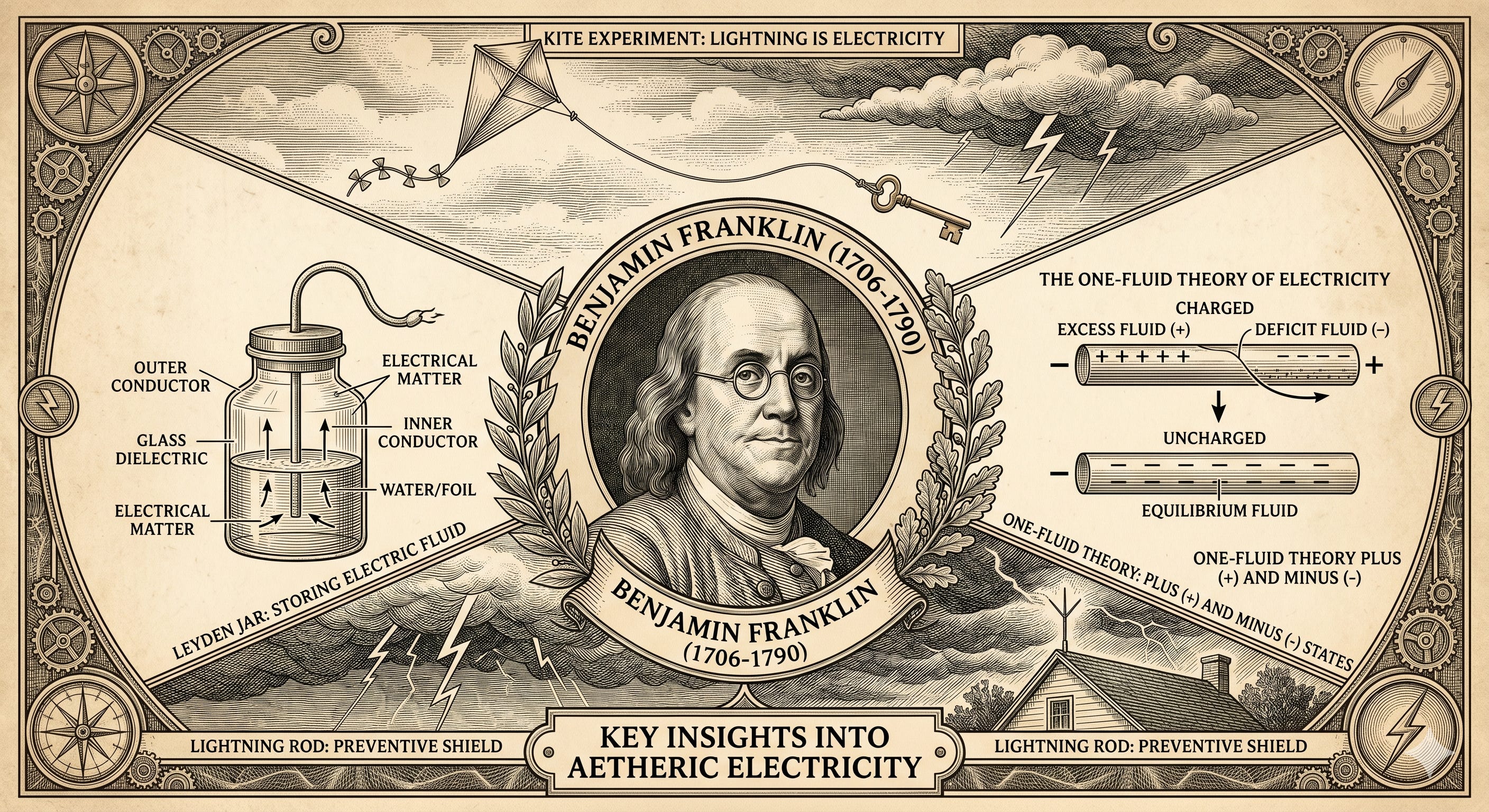
Franklin retired young with great wealth from his own efforts and engaged in politics, writing, philosophy and the cultivation of knowledge and contacts. He grew in stature and power and was a central character in the American War for Independence, the formation of the United States, its early diplomacy and in writing the key documents for the new state. But that is not all. He was an investigator of natural phenomena and was particularly attracted to electricity. Franklin’s most productive years in physics were from 1747-1752 when he confirmed the aetheric medium through experimentation and observation.
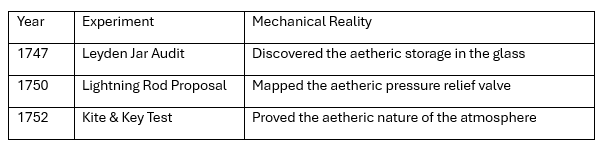
We can have a quick look at what is rarely discussed about Franklin - his physics.
1. The Leyden Jar Experiments (1747–1748)
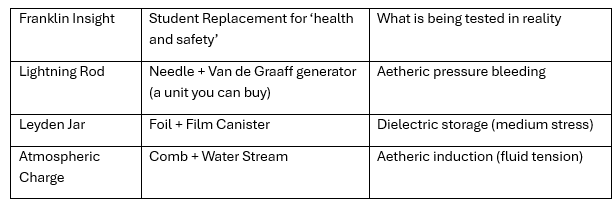
While Franklin didn’t invent the Leyden jar (Musschenbroek 1745), he did spend two years performing experiments with the device. A Leyden jar is a 18th-century precursor to the modern capacitor, consisting of a glass jar coated with metal foil that stores a physical charge of high-pressure aetheric fluid within the glass dielectric (storage or insulation).
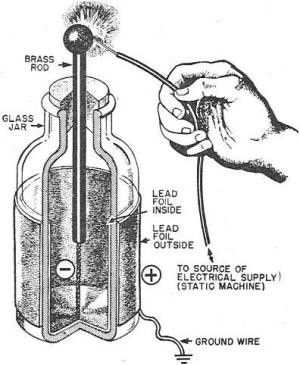
Franklin used the Leyden jar to investigate electricity.
1.1 Spark
Before Franklin, everyone assumed the electrical ‘fluid’ within a Leyden jar was stored in the water or the metal foil inside the jar. In 1748, Franklin proved this to be wrong:
· Steps: Franklin filled a jar with water, charged it and then poured the charged water into a second, uncharged jar.
· Observation: The second jar stayed dead, uncharged. The charge hadn’t moved with the water.
· Next step: Franklin then poured fresh, uncharged water into the first jar and the jar gave a massive spark.
· Insight: This proved that the ‘electric fire’ (his words meaning aether) was not in the conductor but stored in the glass (the dielectric) itself.
1.2. Mechanical Piston Model
Franklin realised that the glass acted like a mechanical spring. He observed and wrote that when using the jar with charged and uncharged water, he was in essence using a friction mechanism to push or pump aetheric fluid into one side of the glass.
· Displacement: Franklin reasoned that since the aether is a substantial fluid, it cannot be compressed without pushing an equal amount out of the other side. This is why the outside of the jar must be grounded.
· Mechanics: Franklin’s insight is exactly how a piston works. You cannot push the piston down unless the air on the other side has somewhere to go.
1.3. Franklin Square (The First Capacitor)
Once Franklin realised the glass was the key, he did away with the bottle shape.
· Flat Glass: He took a flat pane of glass and sandwiched it between two lead plates. This became the ‘Franklin Square’.
· Observation: By doing this, Franklin proved that the ‘electric fire’ was simply a state of aetheric stress within a solid medium. This led directly to the modern capacitor, which funnily enough is the heart of every radio and is found in the S-Band transponder used in the 2026 Artemis mission (or movie).
· Deduction: Franklin therefore knew that ‘electric fire’ was stored in the glass itself (the dielectric).
· Result: This led directly to his ‘One-Fluid Theory’, establishing that electricity is a physical substance that can be compressed or rarefied like a gas.
2. Lightning Rod theory (1750)
In 1750, Franklin sent his famous letter to the Royal Society proposing that lightning was actually a massive aetheric discharge that could be bled off or diverted. In other words lightning was free energy we could use. Franklin needed a high steeple, which in 1750 was not at hand in Philadelphia, so he sent some letters with instructions on how to do the experiment to those who did have access to a high yet grounded observation shed (sentry box or equivalent).
Background: Wait for stormy weather, thunder only, no lightning. Find a tall steeple. Stand inside a small, insulated wooden sentry box or similar within the steeple or high point.
Hardware: Bring a long, vertical iron rod (20–30 feet), with a sharp point, pass this out through the roof.
Process: As a thunder-gust passes overhead, the rod should become energised by the aetheric gradient. The person inside could bring his knuckle near the rod to draw a spark (Franklin did confirm this first-hand so to speak).
Experiment: This setup was achieved by Thomas-François Dalibard in Marly-la-Ville, France, in May 1752, just before Franklin’s own kite experiment (below).
Observed Result: Dalibard and others saw the rod producing sparks during a storm, even though it hadn’t been struck by lightning.
Inference: The atmosphere was permanently electrified (pressurised). The rod wasn’t attracting lightning (there wasn’t any). The rod was acting as a pressure gauge for the aetheric medium between the Earth and the clouds. As written elsewhere when lightning does ‘strike’, the charge needs to be held somewhere (the aether), it is not stored in magic.
3. The Kite and Key Experiment (1752)
Franklin knew the Sentry-Box worked, but he wanted a way to reach the high-pressure layers of the aetheric plenum without building an expensive, complex steeple. So he turned to a kite. The kite would exceed steeple height and act as a mobile terminal. Franklin used the kite as a conductor that he could guide into the vortex of a storm.
The experimental material was simple enough: a kite, a silk handkerchief (the dielectric), a cedar frame (the sentry box he stood in), a hemp string (conductive when wet), and a silk ribbon as insulator for the hand. Franklin was stationary and grounded. He was not running around laughing and telling jokes, flying a kite in a thunder and lightning storm. That is a myth.
Setup
Material: Franklin used a large silk handkerchief instead of paper because it could withstand the friction and stress of a storm.
Wire: He added a sharp pointed wire to the top of the kite to act as a bleed valve.
Conductor: A hemp string served as the conductor and at the bottom of the string, he tied a metal key.
Safety: Between the key and his hand, he tied a silk ribbon (the insulator) and stood under a shed to keep the ribbon dry.
Mechanics
Induction: As the thunderclouds (high-pressure aether) passed over the kite, they induced a charge in the pointed wire.
Conductivity: Once the rain wetted the hemp string, it became a pipe for the aetheric fluid to flow down toward the Earth.
Accumulation: The fluid was blocked by the dry silk ribbon in Franklin’s hand, causing it to pool and pressurise at the metal key.
Visual Proof: Before even touching the key, Franklin observed the loose fibres of the hemp string standing on end, the physical manifestation of aetheric repulsion.
Observations
Spark: When Franklin moved his knuckle toward the key, he drew a spark. This was a miniature version of the lightning bolt above him.
Storage: Franklin successfully charged a Leyden Jar using the energy from the clouds.
Law of Identity: This proved that celestial electricity and terrestrial electricity were the exact same physical fluid.
Usage: This experiment confirmed his theory that Lightning Rods could protect buildings by quietly draining the aetheric pressure of a storm before it turned into a violent discharge. Such rods are used today.
Franklin effectively obtained his ‘electrical fire’ fluid from the sky and stored it in a jar proving that the universe is a unified charged and mechanical system.
To replicate the above at home or at school in a ‘safe setting’ you can use the following and you will get the same results. The author has led some teams through such experiments which again disprove the standard model.
Franklin vs. the ‘Vacuum’ script summarised:
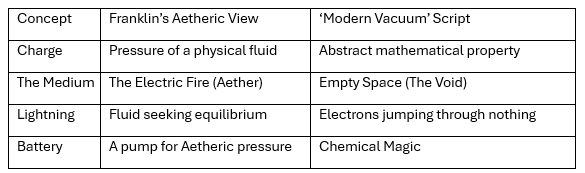
Franklin did not invent the battery (last row above). But he did disprove the allusion to magic that the Standard Model invokes to describe natural battery charging.
There is not a school in the world which teaches any of the information summarised in the above 2 tables. Too much work for the thin armed mathemagicians.
‘One Fluid’ Aetheric Plenum
In the 18th century, scientists (some were called ‘electricians’) were fiercely debating the nature of electricity. The dominant European model was the "two-fluid" theory, which claimed that electricity consisted of two distinct, opposing magical substances that flowed through matter. Franklin offered another theory - the one fluid model. Based on his experiments Franklin claimed the following:
A Universal Fluid: Electricity is a single, continuous, elastic fluid that naturally exists in all matter. It is self-repelling but attracted to ordinary matter. This applies to the entire cosmos.
A Pressure Balance: When an object has its normal, natural allocation of this fluid, it is completely neutral. There is neither a positive nor a negative charge.
Positive vs. Negative: If you rub a glass tube, you accumulate an excess of this fluid (“plus” or positive). If you strip the fluid away, you leave a deficit (“minus” or negative).
Franklin invented the very terms “positive” and “negative” not to describe separate, inherent charges, but to describe a pressure differential in a single medium. His model is far more sensible and empirically proven.
Consider this as well. For Benjamin and the mechanical realists of the 18th century, an artificial vacuum was not “nothingness.” It was simply a space cleared of heavy, coarse atmospheric gas molecules. “Nothing” as a concept cannot, and does not exist.
There exists in the cosmos an underlying fluid medium including the elastic electrical fluid, or the aether, which fills the space between molecules. You can pump the air out of a jar, but you cannot pump out the space itself. You know this from your own common sense. The medium is the fabric that allows the molecules to exist and move in the first place. Scientism rejects this truism.
Bottom Line
If we focus just on physics, Benjamin Franklin is an interesting and rarely discussed case study. He accomplished a number of things that ‘The Science’ will not tolerate.
1. Benjamin knew that ‘positive’ and ‘negative’ charges were due to an excess of aetheric fluid (positive) or a deficit (negative). Franklin proved that aetheric pressure changes induce or create energy and charge.
2. Franklin realised that it is impossible to have a circuit without a container.
3. Franklin did not create a ‘battery’ but he did reconfirm fluid dynamics within the aether.
4. He proved that the aetheric energy including lightning, was conducted and could be harnessed.
The reader will notice just how simple Franklin’s experiments are. You can do them yourself with proper care and protection. Franklin’s great insight was to treat the energy of lightning as a pressurised fluid that could be pumped, stored and drained.
Who else thought like Franklin ? The man who invented the modern AC grid and our technology-driven world - Tesla. The Croatian was another practical engineer who harnessed ‘longitudinal waves’ from the aether and produced ‘free energy’, concepts now denied to exist by ‘The Science’.

The physics of Franklin and Tesla are rarely if ever taught. Money, power, credibility, awards and relevancy are not bestowed on any who venture outside the Scientistic dogma and canons imposed by an unaccountable elite. Further we can state this:
Franklin and those who initiated and fought a war for self-determination and a free society have nothing in common with today’s Church of Scientism, nor with the unbridled power of corrupted and ever-expanding governmental power which uses this same Church to achieve its own ends.
If Benjamin were alive today we can say two things with some degree of certainty. First, he would be an unsurpassed-polymathic success. The man was and still is a template for how to live a full life and achieve the ‘American Dream’. Second, I would surmise that Benjamin would be advocating for a 2nd American revolution - both societal and scientific - and a return to core principles and small government. He would be right to do so as Americans reflect on what has transpired over 250 years of history where the axioms that inspired men and women to fight for freedom have largely been forgotten, buried and replaced by the worship of the state and its religion named ‘The Science’.
All Hail.
next post: Alexander Graham Bell.
==
Sources
Cohen, I.B. (1990). Benjamin Franklin’s Science. Cambridge, MA: Harvard University Press. Academic text proving Franklin viewed electricity as a ‘ponderable fluid’ (aether), aligning his work with the mechanical realism of the 18th century.
Franklin, B. (1751). Experiments and Observations on Electricity, Made at Philadelphia in America. London: E. Cave. In these letters Franklin explicitly describes electricity as a ‘subtle particulate fluid’ that can be condensed or rarefied, effectively defining the aetheric piston.
Heilbron, J.L. (1979). Electricity in the 17th and 18th Centuries: A Study of Early Modern Physics. Berkeley: University of California Press. Provides the broader historical audit of how the Scientistic Establishment transitioned from Franklin’s physical fluid model to the modern, abstract ‘charge’ model.
Schiffer, M.B. (2003). Draw the Lightning Down: Benjamin Franklin and Electrical Technology in the Age of Enlightenment. Berkeley: University of California Press. Documents the practical application of Franklin’s aetheric theories, specifically how the lightning rod was designed to bleed off aetheric pressure before a breakdown occurred.
Whittaker, E.T. (1910). A History of the Theories of Aether and Electricity. London: Longmans, Green, and Co. Whittaker dedicates significant space to Franklin, acknowledging him as the man who simplified aetheric mechanics into a single, workable fluid theory. The single fluid had and has its critics - what else is new. What is not at issue is the relevancy of the aether to natural energy creation.
I'm learning more new and interesting stuff all the time with your posts. Thanks for sharing your learning and insights.
Fascinating article. What a bonus, two excellent, enlightening, lessons, history and physics. Thank you.